How Manteca Contractors Can Double Google Reviews in 90 Days
Automated review generation sends timed text messages after completed jobs, directing satisfied customers to Google while routing unhappy ones to you privately. For Manteca contractors, this system consistently doubles review counts within 90 days.
By Luis Mariscal · AI Automation Consultant, Vox.chat
Share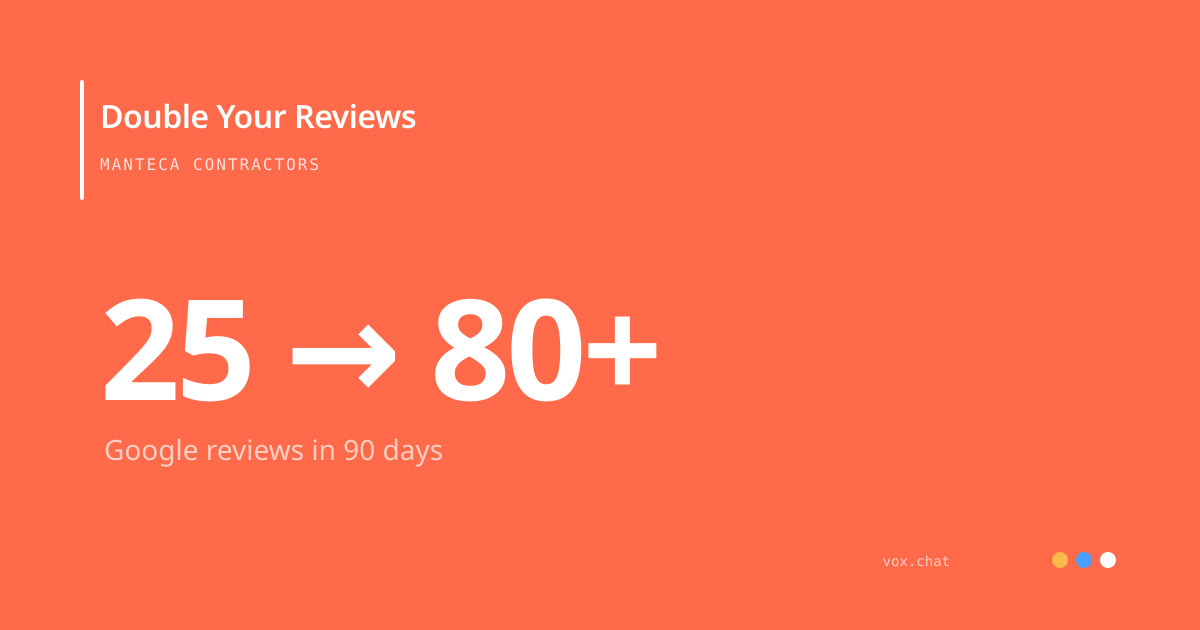
What is automated review generation for contractors?
Automated review generation is the process of sending timed, personalized text messages to customers after a completed service call, directing satisfied customers to leave a Google review while routing dissatisfied customers to the business owner privately. For Manteca contractors — HVAC techs, plumbers, electricians, and roofers serving the 209 corridor from Lathrop to Ripon — this system consistently doubles Google review counts within 90 days.
The system works because it removes the two biggest barriers to getting reviews: remembering to ask, and making it easy for the customer to respond. Instead of relying on a technician to ask at the door (which happens maybe 30% of the time), every completed job triggers an automated, perfectly-timed text message with a one-tap link to your Google Business Profile.
Why Google reviews matter more in Manteca than you think
When a homeowner on Northgate Drive searches "AC repair Manteca" at 9 PM in July — and it's still 98 degrees outside — they're picking from Google's local map pack. The contractor with 120 reviews and a 4.8 rating gets the call. The one with 15 reviews and a 4.5 doesn't even register.
According to BrightLocal's 2024 Local Consumer Review Survey, 87% of consumers read online reviews for local businesses before making a decision. More critically, 73% only pay attention to reviews written in the last month. Old reviews are invisible reviews.
In Manteca's competitive contractor market — where 40+ HVAC companies serve the same zip codes stretching from Tracy to Escalon — review count and recency are the difference between appearing in the map pack and being buried on page two. Google's local algorithm explicitly weighs review signals: quantity, velocity (how fast you're getting new ones), quality, and recency.
Harvard Business School researcher Michael Luca found that a one-star increase in a business's Yelp rating leads to a 5–9% increase in revenue. The same principle applies to Google reviews — and in a market where HVAC jobs average $450–$600 according to ServiceTitan's State of the Trades report, even a modest increase in visibility compounds into serious revenue over a Central Valley summer.
The math: review count vs. map pack visibility
BrightLocal's local ranking study found that businesses with 80+ reviews appear in Google's map pack approximately 3x more often than those with fewer than 20 reviews. For a Manteca plumber or HVAC contractor, the map pack is where 42% of local search clicks go — the rest goes to organic results below.
Here's what that looks like in practice:
- Under 20 reviews: You're invisible in the map pack for most searches. Homeowners in Stockton, Modesto, or Manteca searching for your trade won't see you unless they scroll past the first page.
- 20–50 reviews: You show up occasionally, usually behind competitors with more reviews and higher ratings.
- 80+ reviews: You're a regular in the map pack. Your phone rings more, your website gets more traffic, and you spend less on ads because organic visibility is doing the work.
Each new review is compound interest on your local SEO. The difference between 25 reviews and 80 reviews isn't 3x more reviews — it's potentially 3x more visibility, which translates directly to more calls and booked jobs.
Manual asking vs. automated review requests
The numbers make the case. Manual asking relies on individual technicians remembering, having the time, and feeling comfortable asking every customer — which almost never happens consistently.
| Metric | Manual asking | Automated system |
|---|---|---|
| Reviews requested per month | 5–10 (when remembered) | Every completed job |
| Customer response rate | 1–3% | 10–15% |
| Time spent per request | 2–3 minutes per ask | 0 minutes (fully automated) |
| Consistency | Depends on the tech | Every job, every time |
| Follow-up if no response | Almost never | Automatic at 48 hours |
| Monthly new reviews | 0–2 reviews | 8–15 reviews |
| Negative review filtering | None | Automatic sentiment routing |
How the automated review system works, step by step
The process is fully automated from the moment a job is marked complete in your system — whether that's ServiceTitan, Housecall Pro, Jobber, or even a simple text to your office manager.
- Job completion triggers the sequence. Your technician finishes the install on Yosemite Avenue in Manteca and marks the job done. The system starts the clock.
- 2-hour delay. The customer gets a text 2 hours after completion — not immediately (too soon, feels aggressive), not the next day (they've moved on). Two hours is the sweet spot: the house is cool again, the leak is fixed, they've noticed the improvement.
- Personalized text message. "Hi Mike, thanks for choosing Valley Comfort HVAC. We hope your AC is running great! Would you take 30 seconds to share your experience in a Google review? [one-tap link]"
- One-tap Google review link. The link opens Google Reviews with your business pre-selected. No searching, no navigating — one tap and they're writing. Every extra step loses 50% of respondents.
- 48-hour follow-up. If no response, a polite follow-up goes out: "Hi Mike, just a quick reminder — your feedback helps other Manteca homeowners find reliable HVAC service. Here's the link if you have 30 seconds: [link]"
- Problem alerts. Every customer gets the Google link. If a customer signals a problem, you get alerted right away so you can resolve the issue before it becomes a public 1-star review.
You get a monthly report showing reviews gained, average rating, and response rates. Your involvement after setup? Zero.
What the text message actually looks like
Effective review request texts share three traits: they're personal, they're short, and they make it effortless. Here are templates that consistently perform for Central Valley contractors:
Initial request (sent 2 hours after job):
"Hi [Name], thanks for choosing [Business Name] today! If you're happy with the work, would you take 30 seconds to share your experience? It really helps other [Manteca/Turlock/Modesto] homeowners find us. [Google Review Link]"
Follow-up (sent 48 hours later if no response):
"Hi [Name], just a quick follow-up — your feedback means a lot to our team. If you have a moment: [Google Review Link]. Thanks again!"
Text messages have a 98% open rate compared to 20% for email, according to Gartner research. That's why text-based review requests outperform email requests by 5–8x in the contractor industry.
Common objections — and why they're wrong
"My customers won't respond to texts." They already do — for everything else. Appointment reminders, delivery updates, bank alerts. A BrightLocal survey found that 53% of consumers have been asked to leave a review via text, and those who were asked are 2.7x more likely to actually do it compared to email requests. Text works because people read it.
"Isn't this spammy?" One relevant text after they paid you $500 to fix their plumbing is not spam — it's follow-up. The text goes out once (with one follow-up), it's relevant to a service they just received, and they can reply STOP. Spam is the 14th email from a mattress company. A review request from the plumber who just fixed your burst pipe is customer engagement.
"I already ask my techs to ask in person." And how's that working? Most contractors who track it find their techs ask maybe 3 out of 10 customers. The ones they do ask say "sure" and forget by the time they get home. In-person asks convert at 1–3%. Automated texts convert at 10–15%. The math is not close.
Results timeline: what to expect at 30, 60, and 90 days
Based on data from contractors in Manteca, Turlock, Modesto, and Stockton running automated review systems through peak Central Valley summer season:
Day 1–30: 8–15 new Google reviews. You'll see your average rating stabilize (new reviews dilute any old outliers). Your Google Business Profile will show a "reviews increasing" trend that Google's algorithm rewards.
Day 31–60: 20–35 cumulative new reviews. You'll start noticing more map pack appearances for your primary service keywords. Competitors with stale review profiles start falling behind you. Homeowners in Oakdale, Escalon, and Ripon searching for your trade see you more often.
Day 61–90: 40–60 cumulative new reviews. If you started at 25 reviews, you're now at 65–85. You've likely doubled your count. The compound effect kicks in: more visibility → more calls → more jobs → more reviews → more visibility. Your review velocity is now a competitive moat that's hard for competitors to match without their own automation.
During Central Valley peak season — June through September for HVAC, winter for plumbing — the volume accelerates because you're completing more jobs per week. A contractor running 30 jobs/week with a 12% review response rate adds 3–4 reviews every week. That's 12–16 per month, sustained.
For a deeper look at the full AI automation stack, including voice agents and chat automation, see our complete guide for Central Valley contractors.
Frequently asked questions
How much does automated review generation cost for a Manteca contractor?
Will automated review requests violate Google's review policies?
Can I customize the review request text message for my business?
What happens if a customer is unhappy and I send them a review request?
How long does it take to set up automated review generation?
Do I need to respond to every Google review I receive?
Ready to automate your business?
Book a free consultation — no contracts, cancel anytime.