How to Answer Business Calls While You're on a Job Site
You're on a roof, under a sink, or inside a panel. The phone rings. You can't answer it. By the time you call back, the customer hired someone else. Here are 5 ways contractors handle this — and only one that actually works without ruining your day.
By Luis Mariscal · AI Automation Consultant, Vox.chat
Share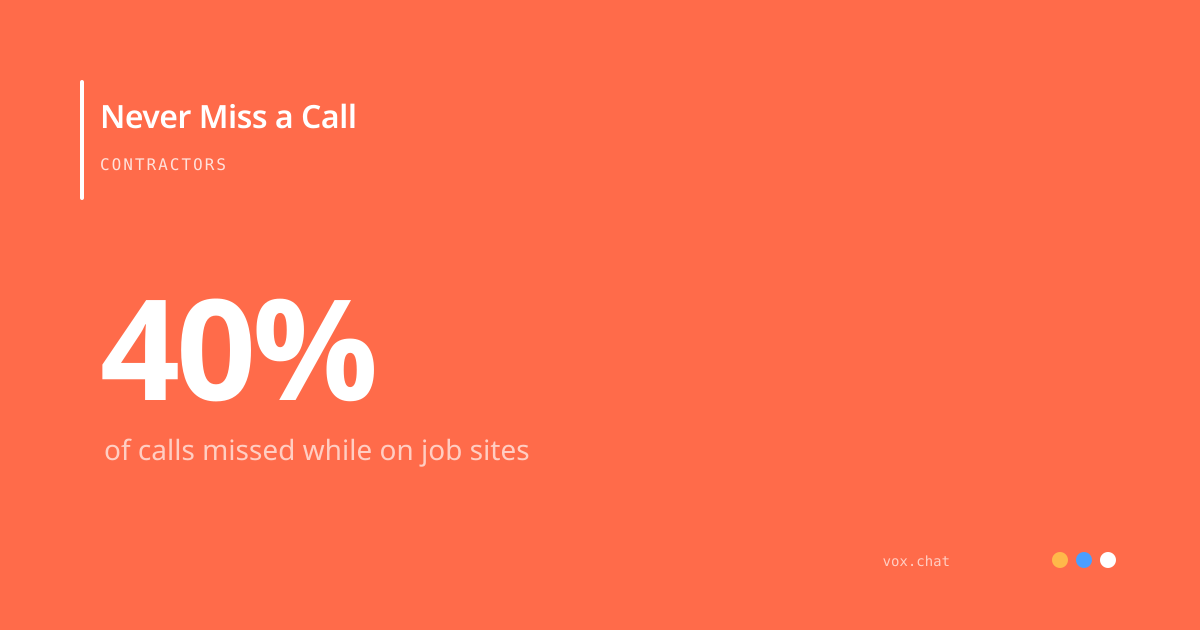
The contractor's phone problem
Every contractor knows this moment. You're two hours into a job — up on scaffolding, elbow-deep in a drain, or pulling wire through a wall — and your phone buzzes. You can see the screen: local number, probably a new customer. But you can't answer. Your hands are full, you're in a crawl space, or you're standing in front of a customer who's paying you $150/hour to focus on their job, not someone else's.
So you let it ring. You'll call back at lunch. Except at lunch you have three missed calls and two voicemails, and by the time you call the first one back, they've already booked with the plumber who picked up on the first ring.
This isn't a discipline problem. It's a physics problem. You can't be in two places at once. And every solution contractors have tried — from carrying two phones to hiring their spouse — creates new problems of its own.
The 5 ways contractors try to solve this
1. "I'll call them back at lunch."
The most common approach, and the least effective. Research from Invoca shows that 62% of callers who reach voicemail call a competitor within 10 minutes. By lunch, the job is gone. You're not calling back a lead — you're calling back someone who already hired someone else. Even when they do answer your callback, the urgency has cooled and your close rate drops by 80% compared to answering live.
2. "My wife/partner handles the phone."
This works until it doesn't. Your partner has their own life, their own job, or their own patience limit. They can take a message but probably can't qualify an HVAC call or check your calendar. And "my wife will call you back" isn't the professional impression you want for a $5,000 panel upgrade lead. Plus, the coverage ends the moment they're unavailable.
3. "I hired an office person."
This solves business hours but costs $35,000–$45,000/year and only covers 40 out of 168 weekly hours. After 5 PM, weekends, and holidays — when emergency calls carry the highest ticket value — you're back to voicemail. And during peak season, one person can't handle the volume.
4. "I answer between tasks."
Dangerous and unprofessional. Answering a call on a ladder is a safety risk. Answering mid-conversation with the customer in front of you signals that someone else is more important. And the call quality is terrible — you're distracted, rushed, and probably can't check your calendar or write anything down. The caller hears it in your voice.
5. "I use an answering service."
Better than voicemail, but an answering service takes messages — it doesn't book appointments. The operator says "someone will call you back," which the caller hears as "maybe." And at $1.50–$3.00 per minute, a busy month can cost $2,000–$4,000. Plus, they don't know the difference between a panel upgrade and a tripped breaker.
The approach that actually works
The solution isn't answering more calls yourself. It's removing yourself from the equation entirely.
An AI phone agent answers every call the moment it rings — while you're on a roof, under a sink, or driving between jobs. Here's what happens:
- Customer calls your business number. Same number on your truck, your Google listing, your cards.
- AI picks up in under 2 seconds. "Thanks for calling [Your Company]. How can I help you today?"
- AI qualifies the call. What's the issue? Is it urgent? What's the address? What type of system? The AI asks the same questions you would — because it's trained on your specific trade.
- AI books the appointment. Checks your calendar, offers available time slots, confirms with the caller. Done.
- You get a text summary. Customer name, phone, address, issue, and booked time — all delivered to your phone in a text message you can read at your next break.
The entire call takes 2–4 minutes. The customer hangs up with a confirmed appointment. And you never had to stop what you were doing.
What changes when you stop answering the phone
Contractors who switch to AI phone handling report the same three changes:
1. Your current jobs get better. You're fully present for the customer in front of you. No phone buzzing in your pocket, no guilt about missed calls, no rushing to call people back at lunch. The quality of your work — and your customer's experience — improves immediately.
2. You stop losing after-hours jobs. The calls that come in at 7 PM, 10 PM, and Saturday morning are now answered and booked. These are often the highest-value calls because they're emergencies — burst pipes, dead AC, electrical outages — with $500–$1,500 tickets.
3. Your stress drops. The mental weight of knowing you're missing calls while you work is real. Contractors describe it as a background anxiety that never turns off. When every call is handled, that weight lifts. You finish the job in front of you, check your phone, and see three new appointments already on your calendar.
Getting started
If you're a contractor who's tried to solve the phone problem with willpower — answering faster, calling back sooner, working through lunch to return calls — stop. The problem isn't your effort. The problem is the model. You're one person trying to do two jobs at once.
Vox.chat's AI phone agent is $595/month with 2,500 voice minutes included. Your first recovered job pays for the entire month. No contracts, no hardware, no setup on your end beyond a 20-minute onboarding call.
The phone stops being your problem and starts being your most reliable source of new business — without you ever having to answer it.
See the full cost breakdown in our receptionist vs AI comparison, or learn how Central Valley contractors are using AI in our complete automation guide.
Frequently asked questions
Will customers know they're talking to AI?
What if a call needs my personal attention?
Can the AI handle multiple trades if I do HVAC and plumbing?
How fast can I get set up?
Ready to automate your business?
Book a free consultation — no contracts, cancel anytime.