Do I Need a Receptionist for My HVAC Company? No — You Need Something Better
You're missing calls, losing jobs, and wondering if it's time to hire a receptionist. Before you post that job listing at $38K/year, consider this: the problem isn't that nobody's answering the phone. The problem is that nobody can answer it 24/7, handle 10 calls at once, and book appointments in real-time.
By Luis Mariscal · AI Automation Consultant, Vox.chat
Share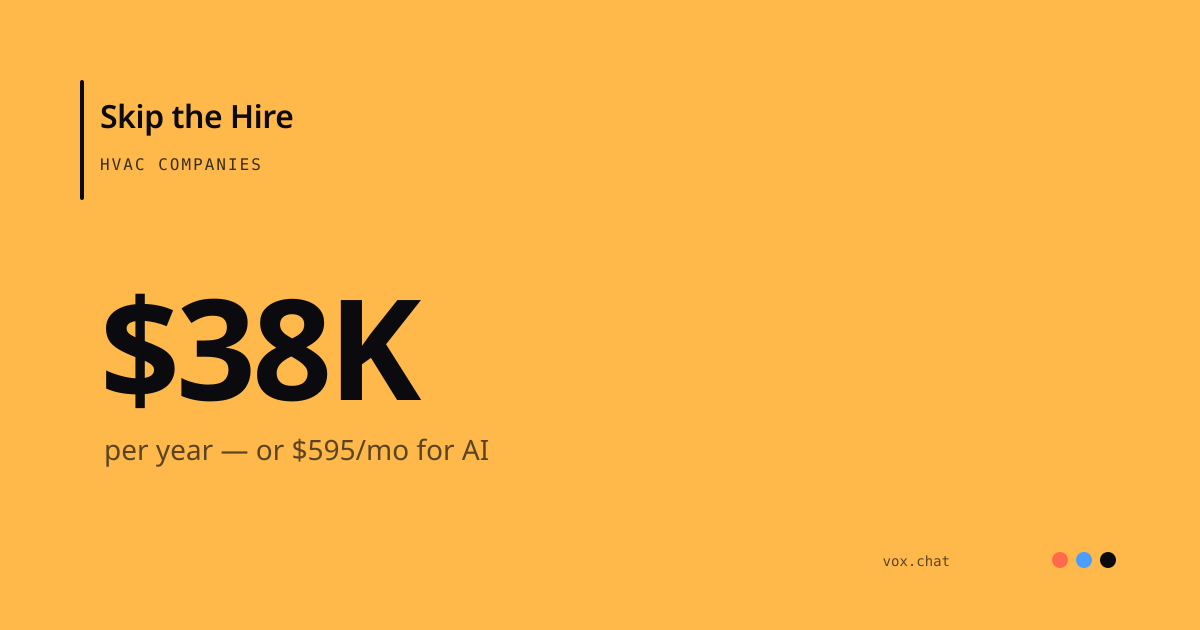
The moment every HVAC owner hits
You started the company alone. You answered the phone between jobs, called customers back from the truck, and somehow kept everything moving. Then you grew. Added a tech or two. Got busier. And now the phone rings constantly and nobody's there to pick it up because everyone — including you — is on a job site.
So you think: "I need to hire a receptionist."
It feels like the obvious next step. And for some businesses, it is. But for most HVAC companies — especially those with 2–10 technicians — hiring a receptionist solves the wrong problem. The problem isn't that you need a person sitting at a desk. The problem is that calls come in 24 hours a day and you can only answer them for 8.
What a receptionist actually costs an HVAC company
Let's be honest about the real cost of hiring a receptionist for an HVAC business:
- Salary: $35,000–$45,000/year ($17–$22/hour)
- Payroll taxes and workers' comp: $5,000–$7,000/year
- Benefits (if offered): $5,000–$12,000/year
- Training time: 2–4 weeks before they're fully effective
- Turnover cost: Average receptionist tenure is 18 months. Hiring, training, and ramp-up costs $3,000–$5,000 each time.
Fully loaded cost: $45,000–$64,000/year.
And for that investment, you get coverage Monday through Friday, 8 AM to 5 PM. That's 40 out of 168 hours per week — 24% of the time the phone could ring. The other 76% still goes to voicemail.
For an HVAC company, peak call hours aren't limited to business hours. Homeowners call when their AC dies — which happens at 6 PM when the day's heat finally overwhelms an aging system, at 10 PM when they realize the house won't cool down for bedtime, and on Saturday afternoon when they're hosting a barbecue in 100-degree heat. Your receptionist isn't working any of those hours.
Receptionist vs AI phone agent for HVAC
| Factor | Human receptionist | AI phone agent |
|---|---|---|
| Annual cost | $45,000–$64,000 | $9,600–$18,000 |
| Hours covered | 40/week (M–F) | 168/week (24/7/365) |
| Simultaneous calls | 1 at a time | Unlimited |
| Lunch/break coverage | Voicemail | Always on |
| Vacation/sick days | 15–25 days/year | Never |
| Peak season scaling | Same capacity | Handles any volume |
| Bilingual (English + Spanish) | Hire specifically for this | Built-in |
| Books to your calendar | Yes — manually | Yes — real-time, automatic |
| Consistency | Varies by mood, workload | Same quality every call |
| Training time | 2–4 weeks | 3–5 days (we handle it) |
| Turnover risk | High — 18-month avg tenure | None |
What a receptionist is good at (that AI isn't)
Before you conclude that AI replaces a receptionist entirely, here's where a human genuinely adds value:
- In-person customer interactions. When a homeowner walks into your office, a human receptionist provides a personal touch that AI can't replicate.
- Complex problem-solving. A longtime receptionist who knows your business can make judgment calls about scheduling conflicts, warranty issues, or upset customers that require nuance.
- Internal coordination. Managing dispatching, coordinating between techs, handling parts ordering, processing payments — these are tasks a receptionist does beyond answering the phone.
The key insight: most of the value a good receptionist provides isn't answering the phone. It's the other 70% of their job. If you need someone for dispatching, office management, and in-person customer service, hire that person. But don't pay $50K/year for phone coverage that only works 24% of the week.
The best setup for most HVAC companies: a part-time office coordinator (for in-person tasks) + an AI phone agent (for all calls, 24/7). You get human warmth where it matters and machine reliability where it counts.
The "I'll just hire someone" math that doesn't work
HVAC owners who hire a receptionist purely for phone coverage often discover a frustrating reality within 90 days:
- The phone still goes to voicemail during lunch, bathroom breaks, and the 15% of calls that come in while the receptionist is already on another call.
- After-hours calls are still missed. Nothing changed for the 76% of the week the receptionist isn't there.
- You're paying a full salary for a half problem. The receptionist handles 25–30 calls per day during business hours but misses the 10–15 calls that come in after hours — the ones with the highest ticket value.
- Summer overwhelms them. When call volume triples during peak HVAC season, one receptionist can't keep up. You need two — doubling your cost.
An AI phone agent handles all of these scenarios at 20–35% of the cost. It answers every call, every time, regardless of volume or time of day. It doesn't eat lunch, take vacations, or quit after 18 months.
What to do right now
If you're at the point where you're considering hiring a receptionist for your HVAC company, you're at the right stage of growth — you have enough call volume that something needs to change. Here's the play:
- Track your missed calls for one week. Check your phone system logs. How many calls went unanswered? How many hit voicemail? What time did they come in?
- Calculate the revenue impact. At $500 average HVAC ticket and a 50% close rate, every missed call costs you $250. Multiply by your weekly missed call count.
- Try an AI phone agent for one month. No contract, cancel anytime. See how many calls it catches that were going to voicemail. Measure the booked appointments.
- Then decide about a receptionist. If you still need someone for in-person office tasks, hire for that — not for phone coverage. You'll hire a better candidate at a lower salary because "answers the phone all day" is no longer the job description.
See how AI answering compares to traditional services in our full comparison, or learn more about the cost of missed calls in our HVAC missed calls report.
Frequently asked questions
Should I fire my receptionist and replace them with AI?
What if my customers prefer talking to a real person?
Can the AI handle complex HVAC scheduling?
What about the personal touch — don't HVAC customers want that?
Ready to automate your business?
Book a free consultation — no contracts, cancel anytime.