AI Answering vs Traditional Answering Services for HVAC Companies
Live answering services take messages. AI answering services book appointments. For HVAC companies where a missed call means a lost $500 job, that difference changes everything. Here's an honest comparison of both — cost, capability, and what actually wins you the job.
By Luis Mariscal · AI Automation Consultant, Vox.chat
Share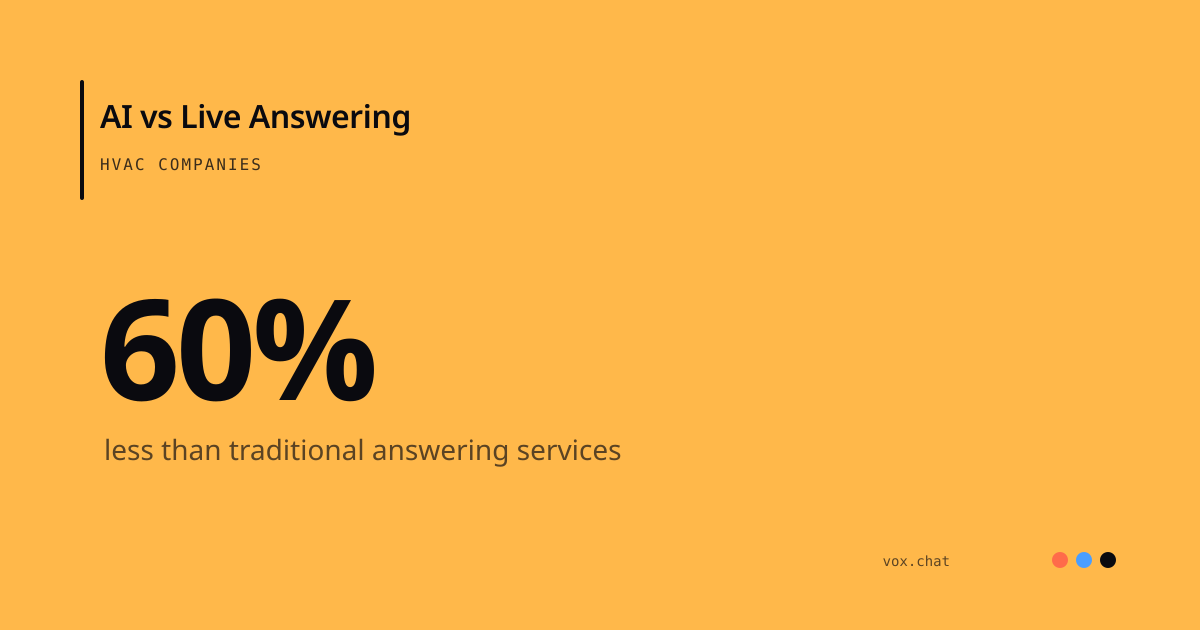
The case for answering services in HVAC
HVAC is one of the most call-dependent trades in the service industry. Your phone rings when someone's AC dies, their furnace won't start, or their thermostat is reading 85 in a house that should be 72. These are urgent calls with high-value tickets, and the contractor who picks up first wins the job.
That's why answering services have been a staple of the HVAC industry for decades. The logic is simple: you can't be on a roof and on the phone at the same time, so someone else answers for you. But in 2026, "someone else" no longer has to mean a human operator reading from a script in a call center. AI answering services now handle the same calls — faster, cheaper, and with more capability.
Here's an honest comparison of both options so you can decide what fits your HVAC operation.
Head-to-head comparison
How traditional live answering services stack up against AI answering for HVAC companies.
| Capability | Traditional answering service | AI answering service |
|---|---|---|
| Answer speed | 15–45 seconds (hold queue) | Under 2 seconds |
| Available hours | 24/7 (at premium rates) | 24/7 (flat monthly rate) |
| Simultaneous calls | 3–8 operators on duty | Unlimited |
| Qualifies HVAC calls | Basic script — "what's the issue?" | Trade-specific — AC vs furnace, emergency vs routine, system age, brand |
| Books appointments | Rarely — takes messages for callback | Yes — real-time calendar integration |
| Notification speed | 5–15 minutes after call | Instant — during the call |
| Handles Spanish calls | Extra cost / limited availability | Automatic language detection |
| Cost (low volume — 200 min/mo) | $300–$600/month | $595/month |
| Cost (high volume — 1,000+ min/mo) | $2,000–$5,000/month | $595/month (flat, up to 2,500 min) |
| Peak season performance | Degrades — longer holds | No degradation — same speed at any volume |
| Knows your HVAC business | Generic script | Custom-trained on your services, area, and pricing |
| Contract terms | 6–12 month contracts common | Month-to-month, cancel anytime |
Where traditional answering services fall short for HVAC
Traditional answering services do one thing: take a message. The operator answers with your company name, writes down the caller's name, number, and a one-line description of the problem, and promises "someone will call you back."
For an HVAC customer whose AC just died in July, "someone will call you back" is functionally identical to voicemail. They wanted an appointment, not a promise. And if your competitor picks up and says "I have a tech available tomorrow at 8 AM," the job is gone before your answering service even emails you the message.
Here's what typically happens during peak HVAC season with a traditional service:
- Hold times spike. The same call center handles hundreds of clients. When it's hot everywhere, every HVAC company is flooding them with calls. Your customers wait 30–60 seconds — and 40% hang up before reaching an operator.
- Operators don't know HVAC. They can't tell the difference between a refrigerant leak and a thermostat issue. They write down "AC broken" and move on. You call back with zero useful information.
- Per-minute billing punishes peak months. A typical 4-minute HVAC call costs $4–$8 in answering service fees. Multiply that by 30 after-hours calls per week during summer and you're paying $480–$960/week — $2,000–$4,000/month — just for message-taking.
- No appointment booking. The operator can't see your calendar. They can't check whether tomorrow at 8 AM is open. The customer waits for a callback that might come in 10 minutes or 10 hours.
Where AI answering services win for HVAC
An AI answering service flips the model. Instead of taking a message and promising a callback, the AI handles the call:
- 2-second pickup. No hold queue, no "your call is important to us," no waiting for an available operator. The AI answers immediately, every time.
- HVAC-specific conversation. The AI knows to ask: Is it the AC or the furnace? Is it blowing warm air or not turning on at all? What brand? How old is the system? Is it a rental or owned property? This information is in your notification before you finish dinner.
- Real-time booking. The AI checks your calendar and offers the caller a specific time: "I have a technician available tomorrow between 8 and 10 AM. Would that work?" The caller hangs up with a confirmed appointment — not a vague promise.
- Flat pricing. Whether you get 5 calls or 50 calls in a day, the price doesn't change. No per-minute billing, no overage charges, no surprise invoices in August when call volume triples.
- Unlimited capacity. When a heat wave hits and 15 homeowners call simultaneously, the AI handles all 15 at once. No hold times, no busy signals, no dropped calls.
The question isn't whether AI is cheaper (it is, at volume). The question is whether it books more jobs. And because it answers faster, qualifies better, and actually schedules the appointment, it does.
When a traditional answering service might still make sense
AI answering isn't perfect for every situation. Here are cases where a traditional service might still fit:
- Very low call volume. If you get fewer than 100 after-hours calls per month, a basic answering service at $200–$400/month can be cheaper than AI. But the moment volume picks up — seasonal spike, a marketing campaign, or natural growth — the per-minute billing catches up fast.
- Highly complex calls requiring human judgment. If your calls routinely require nuanced decisions that go beyond qualification and booking — negotiating a contract, handling a legal issue, managing a genuinely distraught customer in crisis — a skilled human operator adds value. But for the vast majority of HVAC service calls (identify problem, qualify, book), AI handles this faster and more consistently.
- You want a human voice no matter what. Some business owners simply prefer knowing a real person answers. That's valid. Just know that it costs 2–3x more and books fewer appointments.
The bottom line for HVAC companies
If your HVAC company handles more than 15–20 after-hours calls per week, an AI answering service will almost certainly outperform a traditional answering service on both cost and results. The math is straightforward:
- AI costs less at volume. Flat rate vs per-minute billing — at 500+ minutes/month, AI saves 40–60%.
- AI books more jobs. Qualifying + real-time scheduling vs message-taking + callback promises.
- AI never has a bad day. No hold times during peak, no operator calling in sick, no quality variation between shifts.
At Vox.chat, we set up AI answering specifically for HVAC companies — custom scripts, trade-specific qualifying questions, and calendar integration. No contracts, cancel anytime. If it doesn't pay for itself in week one, you walk away with nothing owed.
See the full breakdown of missed call costs in our HVAC missed calls report or learn how other Central Valley contractors use AI in our automation guide.
Frequently asked questions
Is an AI answering service as good as a live person for HVAC calls?
How much does an AI answering service cost compared to a live service?
Can I switch from my current answering service to AI without downtime?
What happens if the AI can't handle a call?
Ready to automate your business?
Book a free consultation — no contracts, cancel anytime.